Your brain has two hemispheres connected by a massive cable called the corpus callosum. Cut it, and you get split-brain syndrome, where the left hand literally doesn't know what the right hand is doing. Except, according to a study in PNAS, that's not quite how it works. Leave just a tiny fragment intact, and your brain keeps working as if nothing happened.
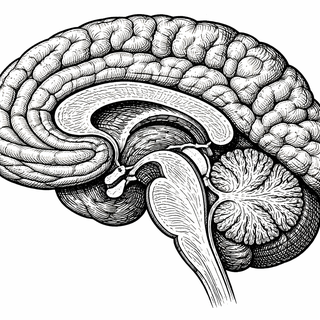
Your brain's backup systems have backup systems. And they're more robust than anyone realized.
The Classic Split-Brain Story (And Why It's Incomplete)
Callosotomy, surgically cutting the corpus callosum, is sometimes performed to treat severe epilepsy that doesn't respond to medication. By disconnecting the hemispheres, you can prevent seizures from spreading across the brain.
The resulting split-brain patients have been studied for decades and have taught us enormous amounts about how the hemispheres specialize. These are the people who can name an object if it's shown to their right visual field (processed by the left hemisphere, which has the language centers) but can only pick it up with their left hand if it's shown to their left visual field (processed by the right hemisphere, which can recognize it but can't say the name).
Fascinating stuff. But here's what the classic story assumed: that the corpus callosum follows a strict front-to-back organizational plan. Anterior fibers handle motor coordination. Middle fibers handle sensory integration. Posterior fibers (in the splenium) handle vision. Cut specific parts, get specific deficits.
The new research throws a wrench into that tidy model.
A Little Connection Goes a Really Long Way
The researchers studied a cohort of adult callosotomy patients using modern neuroimaging and network neuroscience techniques. They looked at patients with varying amounts of the corpus callosum preserved and measured both functional connectivity (whether brain regions were communicating) and behavioral integration (whether the person showed disconnection symptoms).
Here's the shocker: patients with only a tiny fraction of posterior callosal fibers intact retained widespread interhemispheric functional connectivity. They showed no behavioral disconnection at all.
We're talking about 1 centimeter of the splenium. That's it. Leave that little bit intact, and the brain maintains full integration. The hemispheres keep talking. The person shows none of the classic split-brain symptoms.
Only complete callosotomy, cutting literally everything, produced the sweeping disruptions traditionally associated with split-brain syndrome. Anything less, and the brain compensated.
The Textbooks Might Need Some Editing
This finding challenges the classical view of callosal organization. If different fibers have different dedicated functions, you'd expect that preserving only posterior fibers would preserve only posterior functions (mainly vision). Motor coordination, sensory integration, and other "anterior fiber" functions should be disrupted.
That's not what happened. Posterior fibers alone sustained surprisingly complete interhemispheric function across the board. The hemispheres coordinated motor activity, integrated sensory information, and generally behaved as if fully connected.
What's going on? The network architecture appears far more flexible and redundant than anatomical descriptions suggest. Maybe posterior fibers can carry information that we thought was "supposed to" travel through anterior routes. Maybe the brain rapidly reorganizes when some pathways are damaged. Maybe the functional organization was never as anatomically strict as we assumed.
Whatever the explanation, the bottom line is clear: a little corpus callosum goes a remarkably long way.
Why This Matters for Surgery
For neurosurgeons performing callosotomy, this is more than academic trivia. It's practical guidance.
The goal of callosotomy is to reduce seizure spread while minimizing cognitive side effects. If you can achieve seizure control by cutting most of the corpus callosum while preserving a small posterior portion, you might spare the patient from disconnection syndrome entirely.
Previous surgical planning assumed that different sections had different functions, so surgeons tried to balance which deficits were acceptable. But if a small preserved section can sustain widespread integration, the calculation changes. Preserving even a tiny bit of the splenium might be worth significant effort.
This could inform surgical planning to maximize therapeutic benefit while minimizing the cognitive cost. In surgery, knowing what you can get away with removing is as important as knowing what you must preserve.
Redundancy: The Brain's Design Philosophy
This study is another example of a broader theme in neuroscience: the brain is wildly redundant. It has multiple pathways for important functions. It compensates for damage in ways that often surprise us.
We see this in stroke recovery, where people regain function despite permanent damage. We see it in developmental plasticity, where children who lose entire hemispheres can still develop near-normal language and cognition. And now we see it in split-brain surgery, where a fraction of the normal connections sustains complete integration.
The brain didn't evolve for elegant simplicity. It evolved to keep working when things go wrong. Evolution doesn't care if the solution is messy as long as you survive to reproduce. So the brain has layers upon layers of backup systems.
This is reassuring from a survival perspective but frustrating from a scientific perspective. The brain's redundancy makes it harder to figure out what each part actually does, because there's always some other part that can take over.
What This Says About Consciousness
There's a philosophical dimension to these findings too. Split-brain research has been central to debates about consciousness and the unity of mind. If cutting the corpus callosum creates two separate consciousnesses in one body, what does that say about the nature of self?
But if a tiny remnant of connection maintains complete integration, it suggests that the unity of consciousness doesn't require massive information flow between hemispheres. A trickle might be enough.
This doesn't solve the hard problem of consciousness or anything, but it's a data point about how much neural traffic is actually needed for a unified experience. Apparently, not that much.
The Surprising Value of Knowing What You Can Cut
Sometimes the most valuable discoveries come from finding out how much you can remove before things break. This is true in engineering, in biology, and in surgery.
In this case, you can remove almost the entire corpus callosum, and if you leave that last centimeter of splenium, the brain carries on. Full interhemispheric integration. No disconnection symptoms. The massive cable connecting your hemispheres might be mostly redundant.
That's humbling, surprising, and potentially very useful for patients facing this surgery. And it's a reminder that after decades of studying split-brain patients, the brain is still capable of surprising us.
Reference: Santander T, et al. (2025). Full interhemispheric integration sustained by a fraction of posterior callosal fibers. PNAS. doi: 10.1073/pnas.2520190122 | PMID: 41118210
Disclaimer: The image accompanying this article is for illustrative purposes only and does not depict actual experimental results, data, or biological mechanisms.