Back in 2000, researchers discovered something that shouldn't have worked: ketamine, the anesthetic that college students take at raves, could lift severe depression in hours instead of weeks. Traditional antidepressants take forever to kick in. Ketamine just shows up and starts rearranging the furniture in your brain.
Twenty-five years later, it's still working. And we're still standing around scratching our heads about the mechanism. A review in Brain takes stock of what we know about ketamine's cognitive and neuropsychological effects. Spoiler alert: it's less than you'd hope given how long we've been studying this thing.
The Brain's Professional Pessimist
In animal studies, ketamine rapidly affects a brain region called the lateral habenula. This little structure specializes in processing punishment and disappointment. If your brain has a dedicated department for "things that suck," this is it. Every party needs a pooper, and the lateral habenula volunteered for the job.
In depression, the lateral habenula tends to be hyperactive. It's like that friend who can't stop talking about everything that's wrong with the world, except it's a brain region, and it's stuck in the "on" position.
Ketamine also tweaks fronto-striatal reward circuits, the neural pathways involved in motivation and pleasure. The theory goes something like this: depression pushes your brain's emotional dial toward "everything is terrible" and leaves it there. Ketamine shoves it back toward neutral, or maybe even a bit toward "things might actually be okay."
Whether it does this by directly fixing the lateral habenula, by rebooting reward circuits, by doing something else entirely, or by some combination of all of the above, remains a matter of active scientific debate. Which is a polite way of saying nobody's really sure.
Translating From Mouse to Human (Good Luck With That)
Human studies suggest similar mechanisms might be at play, which is encouraging. Ketamine seems to engage reward systems and shift emotional biases in both healthy volunteers and depressed patients. Brain imaging shows changes in the same regions that light up in mouse studies.
But here's where things get tricky. Some findings that looked solid in rodents haven't replicated in people. Others have, but with caveats and complications. The translation from animal model to human patient is always messy, and ketamine is no exception.
Part of the problem is that you can't exactly ask a mouse how it's feeling. You can infer depression-like states from behavior. Does the mouse give up more easily? Does it stop seeking out rewards? But at the end of the day, a mouse can't fill out a questionnaire about its subjective experience of anhedonia. We're inferring a lot from proxy measures, and inferences can be wrong.
Humans can tell you how they feel, but human brains are also more complex than mouse brains, and the relationship between ketamine, brain circuits, and subjective experience adds layers of complication that we're still sorting out.
The Catch: This Drug Is Kind of Intense
On the clinical front, ketamine reliably alleviates depressive symptoms. That's not in dispute. It's particularly effective against anhedonia, that crushing inability to feel pleasure that traditional antidepressants barely touch. People who've felt nothing for months suddenly feel something again. Sometimes after a single dose. Sometimes the effects last for days.
That's remarkable. But there's a catch, and it's not a small one.
The acute side effects are significant. Dissociation. Cognitive impairment. That floaty "am I actually inside my own body right now?" sensation. For some people, this is tolerable or even pleasant in a strange way. For others, it's deeply uncomfortable. It's not exactly a drug you can take and then go about your normal day.
And the long-term safety profile of repeated ketamine use? We're still figuring that out. There's concern about what happens to the bladder with chronic exposure. There's concern about potential addiction. There's concern about cognitive effects from repeated dosing. We're essentially running a large-scale, partially uncontrolled experiment on patients while trying to work out the rules.
What We Actually Want: The Ketamine Experience Without the Ketamine
Here's the real goal of all this research. If we could figure out exactly how ketamine produces its rapid antidepressant effects, we might be able to design new drugs that do the same thing without all the baggage. A pill that lifts depression in hours but doesn't make you feel like you're floating through a dream dimension. A treatment that works on anhedonia without the bladder concerns.
That's the holy grail. A drug that captures whatever ketamine is doing right while avoiding everything it does wrong.
Twenty-five years of research haven't gotten us there yet, but they've taught us a lot. We know more about the brain circuits involved. We know more about the cognitive effects. We know more about the clinical profile. Each piece of the puzzle brings us closer to understanding the whole picture.
Neuroscience's Favorite Mystery
For now, ketamine remains one of the most productive mysteries in neuroscience. A drug that clearly does something profound to depressed brains, even if we can't fully explain what. A treatment that works better than almost anything else for certain patients, even if we don't fully understand why.
It's a reminder that sometimes practice runs ahead of theory. We can use things before we understand them. And sometimes the understanding comes from paying close attention to what works, even when it shouldn't, and slowly piecing together the explanation.
Ketamine works. Why it works is still being figured out. And somewhere in that gap between "it works" and "we know why" lies a whole field of opportunity.
Reference: Costi S, et al. (2025). The cognitive neuroscience of ketamine in major depression. Brain. doi: 10.1093/brain/awaf242 | PMID: 40586138
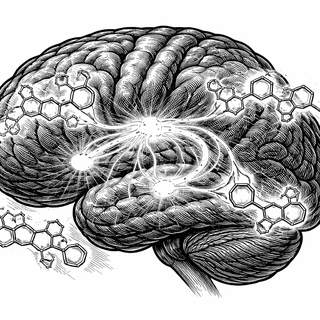
Disclaimer: The image accompanying this article is for illustrative purposes only and does not depict actual experimental results, data, or biological mechanisms.