Predictive coding is everywhere in neuroscience. It has been for years. The theory claims the brain constantly predicts incoming sensory information, with feedback signals suppressing neurons whose activity matches predictions. It is elegant, computationally appealing, and according to a review in Trends in Cognitive Sciences, not what we actually see happening in sensory cortex.
The Beautiful Theory
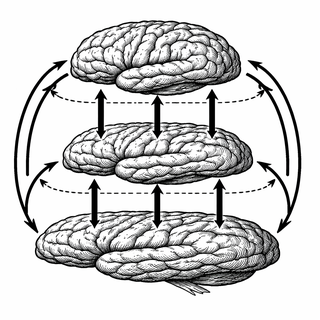
Predictive coding proposes that higher brain areas send predictions down to lower areas. When predictions match incoming signals, activity gets suppressed - only "prediction errors" propagate forward. It is wonderfully efficient. Why waste bandwidth on expected information?
The theory has spawned thousands of papers, computational models, and conference presentations. There's just one awkward detail.
Reality Had Other Plans
When researchers look at actual neural activity during perception, the patterns don't match the theory's predictions. The review catalogs how interactions between cortical areas deviate from what predictive coding says should happen.
For example, attention should increase prediction errors according to the theory. But attentional signals often enhance rather than suppress activity, and they flow in directions the theory doesn't anticipate. When the brain pays attention, it doesn't follow the script.
Enter BELIEF
The authors propose an umbrella term - BELIEF - for alternative theories that better capture what neurons actually do. These frameworks emphasize bottom-up and top-down interactions that coordinate perceptual processing, but through mechanisms different from prediction error minimization.
Instead of predictions suppressing expected activity, these alternatives allow for richer interactions where feedback can both enhance and suppress activity depending on context. More flexibility, less dogma.
Why Should You Care?
Getting the basic framework right matters for understanding brain function. If predictive coding is incorrect, then theoretical work, computational models, and experimental interpretations built on it may need revision. That is a lot of revision.
The brain probably still makes predictions - but the neural circuitry may implement something quite different from what the theory suggests. Brains, it turns out, did not read the theoretical literature before organizing themselves.
Reference: Moore T, et al. (2025). Hierarchical interactions between sensory cortices defy predictive coding. Trends in Cognitive Sciences. doi: 10.1016/j.tics.2025.09.018 | PMID: 41120233
Disclaimer: The image accompanying this article is for illustrative purposes only and does not depict actual experimental results, data, or biological mechanisms.