Here's a thought that should humble every philosopher, physicist, and person who's ever said "I think, therefore I am": what if your brain's primary function isn't thinking at all? What if all that reasoning, planning, and deep contemplation is basically a side project?
A review in Neuron makes this exact argument. The brain's main gig, according to the authors, is allostasis: the predictive regulation of your internal organs' competing demands. Cognition? Emotion? Consciousness itself? These are all built on top of the more fundamental job of keeping your meat suit running.
Your profound thoughts about the meaning of existence are basically a bonus feature on a very sophisticated organ management system.
Allostasis: Homeostasis, But With a Crystal Ball
You've probably heard of homeostasis. It's that textbook concept where your body reacts to disturbances to maintain a set point. Get too hot, you sweat. Blood sugar drops, you get hungry. Simple feedback loops keeping things stable.
Allostasis is homeostasis's smarter, more proactive sibling. Instead of waiting until you're actually dehydrated to do something about it, your brain predicts that you'll need water based on context and experience. It starts preparing before the crisis hits.
Think about it: you get thirsty before you're in danger of dehydration. You get hungry before your blood sugar tanks. You start getting sleepy before you've hit dangerous levels of sleep deprivation. Your brain isn't just reacting. It's anticipating.
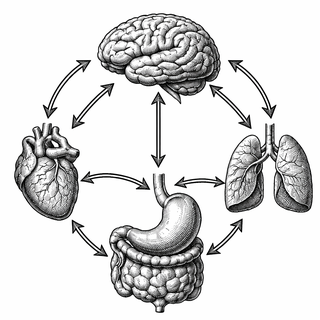
The authors argue this predictive bodily regulation is what brains actually evolved to do. And if you think about it from an evolutionary perspective, it makes sense. The brain is the only organ that can coordinate the competing demands of all your other organs. Heart, lungs, gut, kidneys, liver, they all have different needs that often conflict. Someone has to be the manager, and that someone is your brain.
Wait, But What About All My Beautiful Thoughts?
Here's the uncomfortable part. If the brain's primary function is managing the body's internal economy, where does that leave cognition? Where does that leave your rich inner life, your creative pursuits, your ability to do calculus?
According to this framework, those are all secondary adaptations built on top of the allostatic machinery. They're useful. They help you navigate the world in ways that ultimately serve bodily regulation. But they're not the foundation.
Your ability to plan for the future? Probably evolved to better predict what your body will need. Your capacity for abstract thought? Helps you model the world to anticipate threats and opportunities. Even your emotions, according to this view, are primarily about preparing the body for action based on predicted needs.
It's not that cognition doesn't matter. It's that it matters in service of something more basic: not dying.
The Architecture Tells the Story
The review synthesizes evidence that a distributed allostatic system organizes signaling across the entire brain. And here's where it gets interesting: brain regions we think of as "higher" cognitive areas, like the prefrontal cortex, are deeply interconnected with systems regulating the body.
This isn't an accident. It's not like the cognitive parts of the brain are off in their own tower doing intellectual work while the body-regulation parts handle the plumbing. They're woven together. The same structures that support your abstract reasoning are intimately connected to your heart rate, your gut, your immune system.
The authors argue this architecture places bodily regulation at the very core of brain structure. Everything else is scaffolded on top. When you have a strong emotion, it's not just happening in your head. It's happening in your whole body because the systems are fundamentally integrated.
Rethinking Alzheimer's Through New Glasses
To show this perspective isn't just philosophical hand-waving, the review takes on a practical challenge: understanding Alzheimer's disease through an "allostasis-first" lens.
Traditionally, Alzheimer's is viewed as a cognitive disorder. Memory goes first, then other cognitive functions decline. The pathology is in the brain, specifically those plaques and tangles everyone talks about.
But what if we're missing something by focusing only on cognition? An allostatic perspective highlights that Alzheimer's patients often show metabolic dysregulation, disruptions in peripheral signaling, sleep disturbances, and other bodily issues that precede or accompany cognitive decline.
What if some of these aren't just side effects? What if they're part of the core pathology? The brain is supposed to be managing the body, and when that management system breaks down, the consequences might show up in cognition because cognition is downstream.
This reframing generates new hypotheses. Maybe interventions that target metabolic health, sleep, or other bodily functions could affect disease progression. Maybe looking beyond the brain to the body it manages opens new therapeutic doors.
Why This Should Change How We Study the Brain
The common assumption in neuroscience is that cognition is the brain's primary function. This assumption shapes what questions we ask, what we consider important, and how we design experiments.
But if the authors are right, this assumption is actively misleading us. We've been studying the side hustle while ignoring the main job.
What would neuroscience look like if we took allostasis seriously as the brain's core function? Probably less focus on isolated cognitive tasks performed by people lying motionless in scanners. More focus on how the brain coordinates bodily systems under real-world conditions. More attention to the connections between brain states and peripheral physiology.
It would mean treating the body not as a distraction from "real" brain function, but as the entire point of having a brain in the first place.
The Humbling Takeaway
There's something almost deflating about this perspective. We like to think our brains are for thinking. We identify with our thoughts. The idea that all that mental activity is essentially in service of keeping our organs happy... it's not exactly flattering.
But maybe it's also liberating? If your brain is fundamentally a body-management organ, then taking care of your body isn't separate from taking care of your mind. Sleep, nutrition, movement, they're not obstacles to good thinking. They're the foundation of it.
The deepest questions in neuroscience might not be about consciousness or intelligence at all. They might be about how brains coordinate the messy, demanding, never-ending project of keeping a body alive. Everything else, including this thought you're having right now, is just a fancy bonus.
Reference: Theriault JE, et al. (2025). It's not the thought that counts: Allostasis at the core of brain function. Neuron. doi: 10.1016/j.neuron.2025.09.028 | PMID: 41092898
Disclaimer: The image accompanying this article is for illustrative purposes only and does not depict actual experimental results, data, or biological mechanisms.