Here's a problem that probably never crossed your mind: if you're a scientist studying the microscopic roundworm C. elegans, how do you follow the same individual worm from the day it's born until the day it dies? These critters are about a millimeter long, they wiggle constantly, and picking them up tends to injure or kill them. The usual solution has been to just study lots of worms at different ages and try to piece together what's happening over time.
But that approach has a massive blind spot. A study in eLife introduces a microfluidic platform that solves this problem, essentially building tiny individual apartments where worms can live their entire lives while scientists watch everything that happens.
Why Scientists Are Obsessed With These Tiny Worms
Before we get into the engineering, let's talk about why anyone cares about following individual worms in the first place. C. elegans is one of the most important model organisms in biology. These transparent little nematodes have exactly 302 neurons (we've mapped every single one), they live only about three weeks, their genome is fully sequenced, and they're incredibly easy to grow in labs.
This combination makes them perfect for studying aging, disease progression, and basic biology. You can watch neurons develop, track how diseases spread through tissues, test drugs, and run genetic experiments that would take decades in humans. But here's the catch: most of that work has been done on populations, not individuals.
Imagine trying to understand human aging by taking snapshots of random strangers at different ages. You'd get some general trends, sure. But you'd completely miss how individuals change over time. Does the 70-year-old with great memory have the same brain characteristics she had at 40? No idea, because you didn't follow her.
The same limitation applies to worm research. When you sacrifice animals at timepoints, you lose the individual story.
The Microfluidic Worm Hotel
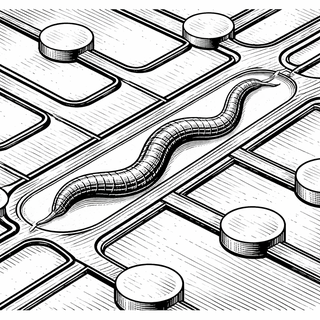
The solution the researchers came up with is genuinely clever. They created a microfluidic platform, essentially a tiny system of channels and chambers etched into a chip, where individual worms can be gently immobilized for imaging without hurting them.
Think of it like a very fancy hotel for worms. Each worm gets its own space. The system can hold it still when you need to take pictures (these are wiggly creatures, remember), then let it go about its business the rest of the time. No handling required, no damage from pipettes or picking tools, just automated gentle restraint when needed.
The platform supports imaging throughout the worm's entire lifespan. Birth to death, all documented for the same individual. And we're not talking about just one measurement here. The system can do functional assays, tracking things like neural activity or muscle function, and can even support downstream proteomics. That means you can watch a worm its whole life, then analyze what proteins were in its body at the end.
What You Can See When You Watch the Whole Movie
Following individuals over time reveals things that population snapshots simply can't show. How does a disease actually progress in a single animal? Does it happen the same way in different individuals, or are there distinct trajectories? When you give an intervention, does it change the slope of decline, delay the onset of problems, or do something else entirely?
Individual variation is one of the most interesting and least understood aspects of biology. Two genetically identical worms, raised in identical conditions, can have different lifespans and show different patterns of decline. Why? You can't answer that question by studying populations at timepoints. You need longitudinal data from individuals.
This matters for aging research especially. We want to understand not just that organisms decline with age, but how that decline happens, what causes variability, and what can change the trajectory. A platform that lets you watch the whole story unfold in the same individual is a powerful tool for tackling those questions.
The Technical Magic
Getting this to work required solving several tricky engineering problems. Worms are small and fragile. They need specific environmental conditions to stay healthy. Imaging them well requires keeping them still, but doing that repeatedly without stress or injury is hard.
The microfluidic approach handles this elegantly. Tiny channels guide fluid flow around the worms, and the chambers can gently immobilize animals for imaging using reversible mechanical constraints. The whole thing is automated, so you can image animals at regular intervals without a researcher having to manually handle each one.
The integration with proteomics is particularly nice. Normally, if you want to know what proteins are in an animal, you have to sacrifice it and analyze the tissues. But what if you've been tracking that specific individual for its whole life? Now you can connect the protein profile to all the behavioral and imaging data you've collected. The life history becomes meaningful in a way that a random population sample can't match.
Open Science Wins
In a move that deserves appreciation, the researchers published enough detail that other labs can build their own versions of the platform. This isn't a proprietary system locked behind patents and expensive licensing. It's open science that can spread through the research community.
That matters because science advances fastest when tools are widely available. If this platform lives only in one lab, its impact is limited. If dozens of labs adopt it, the field can move forward much faster. Different groups can ask different questions, validate each other's findings, and build on shared infrastructure.
The Bigger Picture
This study is ultimately about better tools enabling better science. C. elegans research has been productive for decades using population approaches, but some questions require longitudinal individual data. Now there's a way to get it.
The same principle applies beyond worm research. Individual trajectories matter in all of biology. The more we can track individuals over time rather than relying on population snapshots, the better we can understand how biological processes actually unfold.
Even worms, it turns out, have life stories worth following.
Reference: Bhattacharyya S, et al. (2025). Integrated Microfluidic Platform for Longitudinal Imaging and Downstream Proteomics. eLife. doi: 10.7554/eLife.103937 | PMID: 40937482
Disclaimer: The image accompanying this article is for illustrative purposes only and does not depict actual experimental results, data, or biological mechanisms.