Imagine you've mapped every single wire in a city's electrical grid. Every connection, every junction, every tiny splice. Congratulations! You now have an incomprehensibly massive spreadsheet and absolutely no idea how the city actually powers itself. That's basically the situation neuroscientists found themselves in with connectome data, and a new study in eLife introduces a tool called NeuroSC that might finally help them make sense of the mess.
When "More Data" Becomes "Too Much Data"
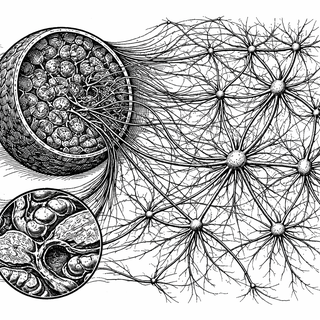
Here's the thing about modern brain imaging: we've gotten really, really good at it. Volume electron microscopy can now image entire brain regions at nanometer resolution. We're talking about seeing individual synapses, those tiny connection points where neurons pass signals to each other. It's like having a microscope so powerful you could read the serial numbers on individual Lego bricks while looking at an entire Lego city.
The result? Terabytes upon terabytes of data containing every cell and every connection in whatever brain region you've imaged. Scientists have literally mapped the complete connectome of a fruit fly's brain. That's around 140,000 neurons and tens of millions of synapses, all catalogued and accounted for.
But here's the awkward part. Having all that data and actually understanding it are two very different things. It's like downloading the entire Library of Congress and then realizing you still can't answer the question you were originally asking. You've got the information, sure, but extracting biological insights from millions of connections requires more than just scrolling through really long spreadsheets.
Enter NeuroSC: The Brain's Data Wrangler
NeuroSC, which stands for Neural Spatiotemporal Collation (scientists love their acronyms), is a platform designed specifically for this problem. It provides tools for quantifying cell biological features within connectome data and relating them to circuit architecture. In plain English: it helps you figure out what all those connections are actually doing.
The platform uses dimensionality reduction, which is fancy talk for "squishing complicated data into something humans can visualize." If you've got a million-dimensional dataset describing neural connections, your eyes and brain literally cannot process that. NeuroSC compresses that information in smart ways that preserve the important patterns while making them visible.
It also employs integrated graph analysis. Think of a connectome as a social network for neurons. Who's connected to whom? Who's the popular neuron that everyone wants to synapse with? Are there cliques of neurons that hang out together? Graph analysis answers these structural questions about the network, which turns out to be surprisingly informative about how the brain works.
Watching the Brain Wire Itself
Here's where NeuroSC really shines: developmental studies. One connectome is interesting. Multiple connectomes from different developmental stages is where things get spicy.
See, brains aren't born fully formed. They assemble themselves over time, with neurons extending axons, forming connections, and then pruning back the ones that don't work out. It's like watching a city build its road system, except the roads are also occasionally deleting themselves and rerouting through new neighborhoods.
By comparing connectomes at different developmental stages, researchers can track how circuits actually come together. Which connections form first? Which ones disappear? How does the overall network architecture change as the brain matures? These questions are basically impossible to answer from a single snapshot, but when you can align data across space and time, patterns start to emerge.
The "spatiotemporal collation" in NeuroSC's name refers to exactly this capability. It's about taking data from different times and places and lining it up so you can see the movie instead of just the still frames.
From Pretty Pictures to Actual Science
Let's be honest: connectome projects generate absolutely stunning images. The visualizations of neural circuits look like something between modern art and alien technology. They're the kind of thing that makes great magazine covers and conference posters.
But pretty pictures alone don't advance our understanding of the brain. The scientific impact of all this data collection depends entirely on our ability to extract actual knowledge from it. What does this wiring tell us about how the brain computes? How does connectivity relate to function? When connectivity goes wrong, what diseases result?
NeuroSC and tools like it are the bridge between the data collection phase and the "actually understanding things" phase. They transform raw connectome data into testable hypotheses about brain development and function. And in a field that's increasingly drowning in data, that kind of analytical infrastructure is worth its weight in gold.
The era of big neuroscience is here. Now we just need the tools to make sense of it all.
Reference: Bhattacharyya S, et al. (2025). Exploring neurodevelopment via spatiotemporal collation of anatomical networks with NeuroSC. eLife. doi: 10.7554/eLife.103977 | PMID: 41118245
Disclaimer: The image accompanying this article is for illustrative purposes only and does not depict actual experimental results, data, or biological mechanisms.