When you walk into a new place for the first time, your brain has to quickly figure out where things are and start building a mental map. Somewhere in your hippocampus, the brain's navigation and memory center, neurons are doing something to encode this new spatial information. But what exactly are they doing in those first moments of exploration, before you've had a chance to really learn the space?
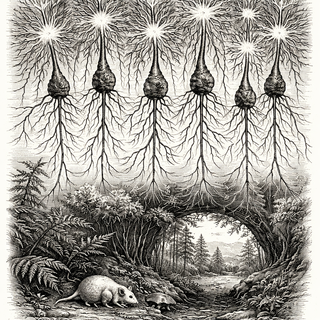
A study in eLife used cutting-edge voltage imaging to watch hippocampal neurons in real-time as mice explored novel environments. What they saw was neurons spontaneously organizing into synchronized groups, like friends coordinating to all shout the same thing at exactly the same time. These neural flash mobs might be the brain's way of planting the seeds that later grow into spatial memories.
The Memory Ensemble Problem
Neuroscientists have known for a while that memories seem to be stored in ensembles, groups of neurons that fire together. The idea is that when certain neurons synchronize their activity, they're binding information together. Neurons that fire together, wire together, as the old saying goes.
Most studies of these ensembles have focused on what happens after the fact. You train an animal on something, then you look at how ensembles replay during sleep (when memories are thought to consolidate). Or you test recall and see which neurons activate together when the memory is retrieved.
But what about the very beginning? What happens in the moment of first exposure, when an animal walks into a new environment and starts encountering new spatial information for the first time? Are ensembles already forming then, or is initial encoding a messier process that only gets organized later?
Voltage Imaging: The Faster Camera
To answer this question, you need to see what neurons are doing with high temporal resolution. Calcium imaging, the usual method for watching large populations of neurons, is relatively slow. It's like watching a movie at low frame rate; you get the general idea, but you miss the fast action.
The researchers used population voltage imaging instead. This technique is faster, capturing the actual voltage fluctuations in neurons at timescales closer to real neural signaling. It's like upgrading from 24 frames per second to 240. You can see the quick coordination that happens when neurons synchronize their firing.
They focused on CA1, a region of the hippocampus famous for its role in spatial memory. CA1 contains "place cells," neurons that fire when an animal is in a particular location. The researchers tracked CA1 pyramidal neurons as mice explored environments they'd never seen before.
The Neurons Start Coordinating Immediately
What they found was that synchronized ensembles form during the very first exploration of a novel environment. This isn't random noise or undirected chaos. Specific groups of neurons lock into synchrony with each other, and the patterns of synchronization aren't arbitrary. They reflect the spatial structure of the environment.
Think of it this way: as the mouse runs around exploring, certain neurons start forming teams. "We fire together when the mouse is in this corner." "We synchronize when it's near that wall." These teams are establishing the neural code for this particular space.
This is happening in real-time, during initial exploration, before any sleep-based consolidation could occur. The synchronous ensembles aren't just a product of memory replay; they're already present during memory acquisition.
Planting Seeds for Future Memories
The findings suggest a new perspective on how spatial memories form. Rather than raw sensory information getting dumped into the hippocampus and then organized later, it looks like organization begins immediately. The first time you encounter a space, your CA1 neurons are already sorting themselves into coherent ensembles.
These initial ensembles might be the seeds that later consolidation processes strengthen and stabilize. Sleep replay, which is known to be important for memory, might not be creating ensemble structure from scratch. It might be reinforcing and refining structure that was already established during initial experience.
This also suggests that the first moments of learning might be more important than we realized. If ensemble formation starts immediately, then the quality of initial encoding matters. Distraction, stress, or anything else that disrupts attention during first exposure might prevent these synchronous patterns from forming properly, potentially affecting how well the memory is later retained.
From First Glance to Lasting Memory
The hippocampus has been called the brain's GPS, and studies like this help explain how that GPS gets programmed. When you walk into a new room, your CA1 neurons aren't just passively receiving sensory information. They're actively organizing, forming synchronized teams that will later serve as the basis for your spatial memory of that place.
It's happening fast, it's happening during the experience itself, and it's remarkably organized from the very start. Your brain doesn't wait until you leave to start remembering where you were. It starts the moment you arrive.
Reference: Bhattacharyya S, et al. (2025). Synchronous ensembles of hippocampal CA1 pyramidal neurons during novel exploration. eLife. doi: 10.7554/eLife.96718 | PMID: 41081764
Disclaimer: The image accompanying this article is for illustrative purposes only and does not depict actual experimental results, data, or biological mechanisms.