
Your nervous system runs on well-insulated wires. The insulation is called myelin, a fatty wrapping that lets electrical signals zip along nerve fibers at high speed. When myelination goes wrong, signals slow down or fail completely, and bad things happen. Conditions like multiple sclerosis and various peripheral neuropathies are all about myelin problems.
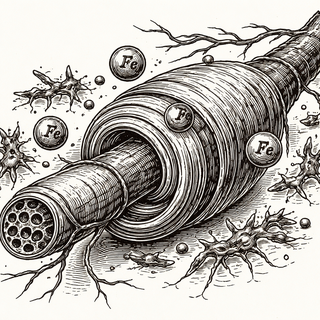
But here's a question that's been harder to answer: why do the cells that make myelin sometimes die in the first place? A study in Cell Reports points to an unexpected culprit: iron. Specifically, a type of cell death called ferroptosis that happens when iron accumulates and starts destroying things. And the story involves a gene that nobody had linked to myelination before.
Meet Med20, the Orchestral Conductor Nobody Was Watching
Med20 is part of something called the mediator complex, which is a group of proteins that helps control gene expression. If your genome is a giant piano, the mediator complex is the person deciding which keys to press and when. Med20 is one member of this ensemble.
Mutations in Med20 have been linked to abnormal brain development in humans. Kids with these mutations have neurological problems. But nobody had really investigated whether Med20 specifically affected myelination.
So the researchers did what researchers do: they deleted Med20 specifically in Schwann cells. These are the cells responsible for myelinating peripheral nerves, the ones that run through your arms and legs and everywhere outside the brain and spinal cord.
The result was clear and not pretty. Without Med20, Schwann cells died, and myelination failed. The peripheral nerves ended up essentially naked, without their insulating wrapping.
Ferroptosis: The Trendy Way to Die
Cell death comes in different flavors. There's apoptosis, where cells essentially commit organized suicide, dismantling themselves neatly. There's necrosis, where cells die traumatically and messily when something catastrophic happens. And then there's ferroptosis, which has become one of the hot topics in cell biology over the past decade.
Ferroptosis is death by iron. When iron accumulates inside a cell, it catalyzes reactions that damage lipids, the fatty molecules that make up cell membranes. The lipids get oxidized, the membranes lose integrity, and the cell dies. It's like rust, but for cells.
Why is this relevant? Because when the researchers looked at what was happening in Med20-deficient Schwann cells, they found all the hallmarks of ferroptosis. Iron was accumulating. Lipids were getting oxidized. The cells were dying in exactly the pattern you'd expect from this mechanism.
A Rube Goldberg Machine of Cellular Destruction
The mechanistic story is a bit of a chain reaction. Med20 normally helps regulate a protein called DDB1. DDB1, in turn, controls the levels of an enzyme called HO-1 (heme oxygenase-1). When everything works properly, HO-1 stays at appropriate levels and nothing bad happens.
When Med20 is missing, DDB1 function is disrupted, and HO-1 levels shoot way up. Here's the problem: HO-1 breaks down heme, and one of the byproducts of heme breakdown is free iron. Too much HO-1 means too much iron release. Too much iron means lipid peroxidation. Lipid peroxidation means ferroptosis. And ferroptosis in Schwann cells means no myelination.
It's like a series of dominoes, each one knocking over the next. Remove Med20, and eventually the whole chain leads to dead cells and bare nerves.
The Part Where There's Actually Hope
Here's where the story takes a more optimistic turn. Unlike some cellular mechanisms that are hard to interfere with, ferroptosis is actually quite druggable. There are compounds that can block it.
The researchers tested two approaches. First, they used ZnPP, an inhibitor of HO-1. By blocking the enzyme that was releasing all that iron, they could prevent the downstream catastrophe. Second, they used Fer-1, a ferroptosis inhibitor that directly blocks the lipid peroxidation step.
Both worked. Med20-deficient mice treated with either drug showed rescued myelination. The Schwann cells survived, the myelin formed, and the nerves got their insulation back.
What This Means for Actual Patients
Now, we're still in mouse territory here, and the path from mouse experiments to human therapies is long and full of disappointments. But the findings do suggest something important: for at least some myelin disorders, ferroptosis might be a therapeutic target.
If you can identify patients whose myelination problems involve Schwann cell ferroptosis, then ferroptosis inhibitors might help. Even if the underlying genetic cause is something you can't fix, preventing the downstream cell death could preserve myelin function.
This adds iron-mediated cell death to the list of pathways that matter for neurological disease. And unlike many cellular mechanisms that researchers discover, ferroptosis is one where we actually have chemical tools to intervene. The drugs exist. They work in mice. The question now is which human patients might benefit.
It's not a cure for anything yet. But understanding that your nerve cells might be dying of iron poisoning is the kind of insight that eventually leads to treatments. Sometimes biology serves up problems that have solutions, and this might be one of them.
Reference: Yang W, et al. (2025). Med20 regulates myelination in the peripheral nervous system by modulating ferroptosis of Schwann cells. Cell Reports. doi: 10.1016/j.celrep.2025.116448 | PMID: 41108685
Disclaimer: The image accompanying this article is for illustrative purposes only and does not depict actual experimental results, data, or biological mechanisms.