
If you want to see neurons firing deep inside a living brain, you face a physics problem. Light scatters quickly in brain tissue, so you can't just shine a light down there and expect to see anything useful. The solution neuroscientists have been using involves implanting tiny glass rods called GRIN lenses (gradient-index lenses) that act like little periscopes, relaying light from deep brain structures up to the surface where you can actually image it.
The problem? These lenses have terrible optical distortions at their edges. So bad that researchers typically only use a small portion in the center, essentially ignoring most of the lens because the image quality out there is garbage. A study in Nature Communications presents a fix that's almost embarrassingly simple: design a correcting lens that compensates for those distortions. The result is roughly four times more usable field of view. Same brain lens, much bigger picture.
Sometimes the best solutions are the ones nobody thought to try.
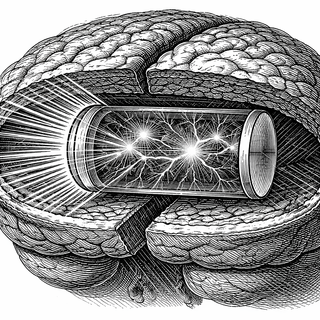
Why GRIN Lenses Are Amazing But Also Kind of Terrible
Fluorescent calcium imaging has completely transformed how neuroscientists study brain activity. You make neurons express a fluorescent indicator that glows when they're active, then watch them light up in real time. It's beautiful, and it tells you exactly which neurons are doing what.
But there's a depth limit. The brain is dense tissue, and light bounces around and gets absorbed. Past a certain depth, you're not going to see anything from the surface. And some of the most interesting brain regions, like the hippocampus (memory) or the striatum (action selection), are buried deep.
GRIN lenses solve this by physically getting the optics closer to the action. You implant a thin glass rod, and it relays images from deep structures up to where your microscope can see them. It's invasive, sure, but it works. Researchers have been using these for years.
The catch is that GRIN lenses have nasty aberrations, especially toward their edges. The image gets blurry, distorted, and basically unusable once you move away from the center. This means you're paying the cost of implanting a lens but only getting data from a fraction of its area. You've drilled a hole in someone's skull (or more likely, a mouse's skull) and inserted a little periscope, and then you can only peek through the middle of it.
This has been a known limitation for a while. Everyone just lived with it.
The Obvious Fix Nobody Did
The researchers behind this study did something that sounds almost too simple: they designed a specialized objective lens that corrects for the known aberrations of GRIN lenses. It's like putting on glasses that are specifically designed to counteract the distortions of a particular window you're looking through.
The correcting lens works with standard 0.5 mm diameter GRIN lenses, which are the most commonly used size in the field. It integrates into existing imaging systems without requiring a complete overhaul of the setup.
The result is dramatic. The usable field of view increases by roughly 400%. You can now get good image quality across essentially the entire lens aperture, not just the center. Same GRIN lens implanted in the same brain, but now you're seeing four times as much.
What You Can Actually Do With This
Using their corrected imaging system, the research team demonstrated volumetric calcium imaging of over 1,000 neurons through a single GRIN lens in deep brain regions of living mice.
That's not just a bigger 2D picture. This is 3D volumetric imaging, meaning they can capture neural activity across multiple focal planes. You're getting the full spatial context of what's happening in that chunk of brain tissue, not just a single slice.
For anyone trying to understand how neural circuits work, this is a big deal. Circuits don't live in flat planes. Neurons are arranged in three-dimensional space, and their connectivity and coordination happens in 3D. Being able to record from a thousand neurons in a volume, rather than a hundred neurons in a plane, opens up entirely different kinds of analysis.
Population-level studies of deep brain circuits that would have required implanting multiple lenses (with all the associated tissue damage and complexity) can now be done with a single implant. More neurons, less surgery, simpler experiments.
The Practical Beauty of Simple Fixes
What makes this solution particularly appealing is its simplicity. It's not some exotic adaptive optics system that requires a million-dollar investment and a PhD in optical engineering to operate. It's a swap-in upgrade. You take your existing imaging rig, swap in the correcting objective, and you're good to go.
For neuroscience labs that are already using GRIN lenses for deep brain imaging, this could be an easy win. You don't need new GRIN lenses. You don't need to redesign your experiments. You just need better optics on the other end of the system.
The fact that this wasn't done earlier is one of those things that's obvious in hindsight. GRIN lens aberrations were a known problem. The idea of correcting for them with a matching optical element is not rocket science. But nobody had actually gone through the effort of designing and building the correction optics.
Sometimes progress in science comes from elaborate new technologies. And sometimes it comes from someone finally getting around to solving a known problem with a straightforward solution. Both count.
The Bottom Line
Neuroscientists have been implanting GRIN lenses to see deep brain activity but only using a fraction of each lens due to optical distortions. A new correcting lens fixes those distortions and quadruples the usable field of view. Over 1,000 neurons can now be imaged through a single lens in 3D.
It's a reminder that the tools we use often have hidden limitations that we just accept, until someone decides to actually fix them. Upgrade your lens, upgrade your data.
Reference: Wang Z, et al. (2025). Large field-of-view volumetric deep brain imaging through gradient-index lenses. Nature Communications. doi: 10.1038/s41467-025-64529-1 | PMID: 41145485
Disclaimer: The image accompanying this article is for illustrative purposes only and does not depict actual experimental results, data, or biological mechanisms.