
Here's a plot twist in neurodegeneration research: there's an immune signaling pathway that can kill neurons without actually involving the immune system. It's like finding out a fire alarm can burn down your house all by itself, no actual fire needed.
The pathway is called STING (Stimulator of Interferon Genes, because scientists love a dramatic acronym), and according to a study in Cell Reports, it's been quietly causing trouble in neurons while everyone was watching the immune cells.
Wait, What's STING Doing in Neurons?
STING is traditionally thought of as an immune system component. Its normal job is to detect foreign DNA (like from viruses or bacteria) and then sound the alarm to trigger inflammatory responses. It's been linked to autoimmune diseases like lupus and also, increasingly, to neurodegenerative conditions like ALS and Parkinson's disease.
The assumption has generally been that when STING contributes to neurodegeneration, it's doing so by revving up immune cells and causing inflammation that damages the brain. Microglia get activated, inflammatory signals fly around, and neurons get caught in the crossfire.
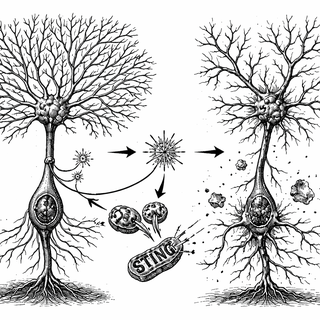
But here's what the researchers discovered: Purkinje cells, those beautiful, elaborately branched neurons in the cerebellum that are responsible for motor coordination, actually express STING protein themselves. This wasn't common knowledge. Nobody had really looked closely at whether neurons have their own STING machinery.
Turns out they do. And that changes everything about how we think about STING-related neurodegeneration.
The Experiment That Flipped the Script
The researchers engineered mice with a clever genetic trick. They created animals that expressed a constitutively active version of STING, but only in Purkinje cells. This meant STING was always "on" in these specific neurons, but nowhere else in the body.
If the prevailing theory was correct (STING kills neurons by causing inflammation), then activating STING only in neurons shouldn't cause much damage. There wouldn't be immune cells going haywire because STING wasn't active in immune cells.
What actually happened: the mice's Purkinje cells died progressively, leading to cerebellar atrophy and severe motor impairments. The mice got worse and worse at coordinating their movements, which is exactly what you'd expect when Purkinje cells are dying.
But here's the kicker: there was no microglial activation. No inflammation. The immune system wasn't participating in the destruction. STING was killing neurons all on its own.
Skipping the Usual Inflammatory Steps
Normally, STING works by inducing type I interferons, which are signaling molecules that activate various immune responses. This interferon pathway has been considered essential for how STING causes damage.
Not in this case. The researchers found that neurodegeneration occurred without interferon production or signaling. STING was somehow toxic to neurons through a different mechanism entirely, one that bypassed the inflammatory cascade.
This is weird and important. It means STING has what scientists call "cell-autonomous" toxic effects in neurons. The pathway doesn't need help from the immune system to destroy brain cells. It can do the job internally, within the neuron itself.
Why This Matters for Treating Neurodegenerative Diseases
For years, the assumption in STING-related neurodegeneration research has been: if we can calm down the inflammation, we can protect the neurons. Anti-inflammatory strategies, targeting microglia, blocking interferon signaling. These seemed like reasonable approaches.
But if STING can kill neurons directly without inflammation, then targeting inflammation alone isn't going to cut it. You might successfully calm down the immune response and still watch neurons die because STING is active inside the neurons themselves.
This suggests that effective therapies might need to block STING activity within neurons, not just in immune cells. Different drug targets, different delivery strategies, different therapeutic approaches entirely.
The Bigger Picture of Neuron-Intrinsic Pathology
This study is part of a growing recognition that neurons aren't just passive victims of immune system chaos. They can participate actively in their own demise through pathways traditionally associated with immune function.
It makes evolutionary sense, in a dark way. If a neuron is infected with a virus, having an internal self-destruct mechanism might be better than letting the virus replicate and spread. STING in neurons might be a suicide switch for infected cells.
But when this pathway gets triggered inappropriately, whether by accumulated cellular damage, metabolic stress, or genetic mutations, neurons die when they don't need to. Understanding exactly how STING kills neurons without inflammation could reveal entirely new therapeutic targets.
The cerebellum's elegant Purkinje cells, famous for their intricate branching and role in motor control, just taught us something unexpected about how neurons can destroy themselves. Sometimes the most dangerous threat isn't outside the cell. It's already inside, waiting to be triggered.
Reference: Bhattacharyya S, et al. (2025). Autonomous STING signaling in Purkinje cells drives neurodegeneration independent of type I interferon. Cell Reports. doi: 10.1016/j.celrep.2025.116480 | PMID: 41166304
Disclaimer: The image accompanying this article is for illustrative purposes only and does not depict actual experimental results, data, or biological mechanisms.