
You know what astronomers and neuroscientists have in common? They're both trying to look at things through stuff that distorts their view. For astronomers, it's the atmosphere making stars twinkle. For neuroscientists, it's thick tissue turning their carefully focused light into mush. And according to a study in eLife, the same trick astronomers use to photograph distant galaxies can now help scientists see tiny structures deep inside brain tissue. Sometimes the best solutions come from the strangest places.
Why Looking Deep Is Hard
There's a type of microscopy called 3D structured illumination microscopy (3D-SIM) that doubles the resolution of regular light microscopy. It works by projecting carefully designed light patterns onto your sample and computationally reconstructing high-frequency details that normally get lost. Pretty clever, and it produces beautiful, detailed images.
The catch? It only works near the surface. Go deeper than about 10 micrometers into thick tissue and the image falls apart. The tissue itself distorts the light, corrupting those carefully designed illumination patterns. It's like trying to read through a frosted glass shower door. The information is technically still there, but good luck making sense of it.
If you want to see subcellular structures in their native tissue context, not just cells flattened on a thin piece of glass, you're stuck. Or at least, you were stuck.
The Telescope Trick
Astronomers faced a similar problem decades ago. Earth's atmosphere is constantly moving and distorting light from space. That's why stars twinkle, which is romantic for stargazing but terrible for doing actual astronomy. Their solution was adaptive optics: deformable mirrors that measure atmospheric distortion in real time and bend to compensate. Modern ground-based telescopes can now produce images almost as sharp as space telescopes, all because they taught their mirrors to undo what the atmosphere does.
The researchers behind Deep3DSIM borrowed this idea. They integrated adaptive optics into their structured illumination microscope, using deformable mirrors to correct for the distortions caused by tissue. Instead of fighting the atmosphere, they're fighting brain tissue, but the principle is the same.
Bending Light to Fix Light
The system works by measuring how the sample distorts the illumination pattern and then adjusting the mirror to pre-compensate. It's like if you knew the shower door was frosted, so you deliberately wrote your message backward and distorted to counteract it. The tissue still does its distorting thing, but the mirror has already bent the light in the opposite direction, so they cancel out.
With Deep3DSIM, they can now maintain the structured illumination quality needed for reconstruction even deep in tissue. The mirrors bend to compensate for what the tissue does to the light, preserving the super-resolution capability at depths that were previously impossible.
Seeing Cells Where They Actually Live
Why does depth matter? Because cells don't exist on glass slides in real life. They exist in three-dimensional tissue, surrounded by other cells, connected to blood vessels and extracellular matrix, embedded in their native environment. A lot of what makes cells interesting, especially in the brain, is their three-dimensional organization and connections.
Flattening everything onto a thin slice tells you something, but it's like understanding a city by looking at individual floor plans rather than seeing the actual buildings. Deep3DSIM lets researchers visualize subcellular structures in their native tissue context, seeing how things are actually organized in 3D rather than just guessing from 2D sections.
Open-Source Science
In a move that deserves appreciation, the authors provided both the optical design and the analysis framework for implementing Deep3DSIM. Labs with existing SIM systems can potentially upgrade their capabilities without starting from scratch. This isn't a proprietary black box; it's a blueprint for the whole field.
That's how science is supposed to work. You figure something out, you share how you did it, everyone benefits.
Borrowed Solutions, Genuine Progress
There's something satisfying about this story. Astronomers needed to see through the atmosphere, so they invented adaptive optics. Decades later, neuroscientists needed to see through tissue, and they realized the same solution could work with modifications.
Deep tissue and high resolution, together at last. It took borrowing technology from people looking at galaxies to help people looking at cells, but sometimes the best scientific progress happens when fields talk to each other. Who would have thought that looking at the stars would help us understand the brain?
Reference: Bhattacharyya S, et al. (2025). Deep3DSIM: Super-resolution imaging of thick tissue using 3D structured illumination with adaptive optics. eLife. doi: 10.7554/eLife.102144 | PMID: 41150055
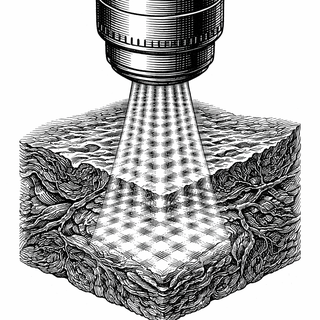
Disclaimer: The image accompanying this article is for illustrative purposes only and does not depict actual experimental results, data, or biological mechanisms.