On February 5, 2025, in Strasbourg, France, researchers highlighted something weird: brains linked to amyotrophic lateral sclerosis, or ALS, seemed to fumble the fine print of sleep before the usual headline symptoms took over. Not the big, obvious "did you sleep or not?" stuff. The micro-stuff. The tiny nighttime rhythms that keep memory organized and keep the cortex from acting like a group chat with no moderator.
ALS is usually introduced as a motor neuron disease, which is accurate in the same way "the stock market involves numbers" is accurate. True, but missing the chaos. Researchers have been building the case that ALS is a brain-wide disorder, with effects that can touch cognition, behavior, metabolism, and sleep.
In this study, researchers used full sleep-lab recordings - EEG, eye movements, muscle activity, the whole glamorous bundle of wires. They studied 33 people with early-stage ALS, 57 symptom-free carriers of ALS-linked mutations such as SOD1 and C9ORF72, and matched control groups. Crucially, they excluded people with major respiratory problems, because sleep issues in ALS often get dumped into the "breathing trouble" bucket. This team wanted to know whether the brain itself was already misbehaving earlier.
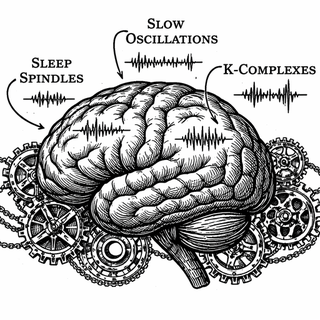
Their answer was yes. People with early ALS - and even presymptomatic gene carriers - had fewer sleep spindles, fewer slow oscillations, and fewer K-complexes. Those are not decorative EEG squiggles. Spindles help memory processing, slow oscillations help time communication across sleeping brain networks, and K-complexes help the brain react without fully waking up. If sleep is your brain's overnight shipping network, these are the barcodes, forklifts, and warehouse managers.
Why These Tiny Signals Matter
Here is the sneaky part: these sleep features tracked with cognitive performance, especially memory, verbal fluency, and language. That matters because ALS does not just hit movement. In many people, it also strains thinking and behavior.
So the paper is making a stronger argument than "people with ALS sleep badly." It is saying the brain's internal timing signals may be disturbed early, broadly, and in ways that line up with cognition. That shifts sleep from side quest to possible biomarker.
There is also a nice bit of scientific stubbornness here. The researchers repeated the findings in three ALS mouse models. Then they showed that spindle deficits could be improved in mice by boosting melanin-concentrating hormone, or MCH, and by blocking orexin signaling with a dual orexin receptor antagonist. Translation: the hypothalamus - one of the brain's sleep-and-appetite control freaks - may be involved.
The Brain’s Supply Chain Problem
This fits a broader trend in ALS research. Recent work has shown less efficient sleep and less slow-wave sleep in ALS (Zhang et al., 2023). Other studies point to hypothalamic MCH neuron loss (Hanke et al., 2023) and altered noradrenergic signaling with cortical hyperexcitability before symptom onset (Scekic-Zahirovic et al., 2024). Reviews of neurodegeneration have been warning that circadian and sleep disruption might be part of the machinery, not just a side effect (Abbott et al., 2021; Videnovic et al., 2021).
Put differently, ALS may be less like a single broken wire and more like a failing logistics network. Signals arrive late. Managers stop coordinating. Night crews miss their shifts. By the time muscles show the problem in daylight, the overnight economy may already be in recession. The brain, rude as ever, rarely sends a neat memo.
What This Could Mean in Real Life
If these findings hold up, sleep studies could become more useful in early ALS assessment, especially for people at genetic risk. Not because a spindle count will magically diagnose the disease tomorrow morning - it will not - but because it could add another noninvasive readout of early brain dysfunction.
There is also a practical clinical angle. Sleep complaints in ALS are often interpreted through the usual suspects: weak breathing muscles, discomfort, cramps, anxiety, medication effects. Those still matter. But this study suggests some sleep changes may be primary brain changes, not just downstream collateral damage.
The catch, because science always keeps one hand on your wallet, is that this is not yet a treatment paper for humans. The MCH and orexin results were in mice. Human sleep is messy, ALS is heterogeneous, and translating a neat mechanistic finding into a safe therapy is where many elegant ideas go to develop an expensive personality disorder.
Still, the core message lands: ALS may disturb the sleeping brain earlier and more broadly than we thought. And if the disease starts reshaping the brain's night shift before the daytime symptoms get obvious, then listening more carefully to sleep might help us catch the story sooner.
References
- Lang C, Guillot SJ, Lule D, et al. Early brain-wide disruption of sleep microarchitecture in amyotrophic lateral sclerosis. J Clin Invest. 2025. DOI: 10.1172/JCI194555. PubMed: PMID 41196652.
- Zhang Y, Ren R, Yang L, et al. Sleep in amyotrophic lateral sclerosis: A systematic review and meta-analysis of polysomnographic findings. Sleep Med. 2023;107:116-125. DOI: 10.1016/j.sleep.2023.04.014. PubMed: PMID 37163838.
- Hanke D, de Calbiac H, Ferrat X, et al. Loss of hypothalamic MCH decreases food intake in amyotrophic lateral sclerosis. Acta Neuropathol. 2023;145(6):733-755. DOI: 10.1007/s00401-023-02569-x. PubMed: PMID 37058170.
- Scekic-Zahirovic J, et al. Cortical hyperexcitability in mouse models and patients with amyotrophic lateral sclerosis is linked to noradrenaline deficiency. Sci Transl Med. 2024;16(738):eadg3665. DOI: 10.1126/scitranslmed.adg3665. PubMed: PMID 38478631.
- Abbott SM, Videnovic A. Defining circadian disruption in neurodegenerative disorders. J Clin Invest. 2021;131(19):e148288. DOI: 10.1172/JCI148288. Full text: JCI.
- Videnovic A, et al. Circadian rhythms in neurodegenerative disorders. Nat Rev Neurol. 2021. DOI: 10.1038/s41582-021-00577-7.
Disclaimer: The image accompanying this article is for illustrative purposes only and does not depict actual experimental results, data, or biological mechanisms.