
Ramón y Cajal famously said that every person can become the sculptor of their own brain. Major depression, though, sometimes seems to hand the chisel to a chaotic intern who keeps sanding the wrong parts and telling the salience network to panic about everything. A new 2025 umbrella review in Molecular Psychiatry asks whether depression shows a pattern or whether neuroscientists have been squinting at scanner blobs [1].
The answer is yes. Not a single "depression spot" in the brain - that idea has aged about as well as low-rise jeans - but a repeatable imbalance across big networks. The result looks less like one faulty switch and more like a relationship crisis between networks that should be coordinating but keep leaving each other on read.
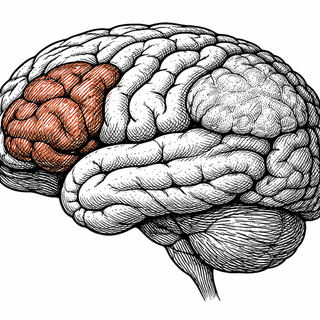
The Brain's Attention Bouncer Starts Overreacting
Three networks do most of the dramatic work here. First, the ventral attention or salience network, which helps flag what matters. Think of it as the nightclub bouncer for your mental life. Normally it decides what deserves attention and what should stay outside in the rain. In depression, this review found the salience network tends to run hot, with increased activity across illness stages and reduced gray matter in some of its key regions, especially around the insula [1].
That matters because the salience network helps switch your brain between internal thought and the outside world. When it gets weird, everything can feel too loud, too threatening, or too emotionally sticky. Recent work in Nature pushed a similar idea further by showing that a salience-related frontostriatal network can appear expanded in people with depression, hinting that this may be a stable systems-level trait rather than a passing mood effect [2]. So yes, the brain's alert system may be acting like that ex who reads "k" as a declaration of war.
Meanwhile, the Sensory Side Goes Weirdly Quiet
The second finding is almost the opposite. Networks involved in somatomotor and visual processing showed reduced intrinsic activity in depression, and that pattern looked stable over time [1]. Depression is not just "sad thoughts." It may also involve the brain becoming less well-tuned to incoming sensory and bodily information.
That fits the lived experience better than a lot of old cartoons about serotonin and rain clouds. Depressed people often describe the world as flattened, slowed, unreal, or emotionally far away. Food tastes duller. Movement feels heavier. The room is right there, but your mind is renting an apartment three blocks inland. The authors argue this "detuning" from the environment may be central, not secondary [3,4].
The Default Mode Network Does What It Always Does - Then Overdoes It
Then there is the default mode network, the system most associated with internally directed thought, self-reflection, memory, and the kind of mental wandering that is either insight or a terrible idea depending on the hour [5]. In this review, it showed decreased activity early in illness but increased activity in chronic depression [1].
That stage-dependent flip matters. It suggests depression may not be a static brain state. Early on, the system may be trying to compensate. Later, chronic network imbalance may harden into a more entrenched pattern.
This might also help explain why depression can become so repetitive and self-sealing. When internally focused networks become miscalibrated while salience systems keep tagging the wrong stuff as important, your brain can end up trapped in a bad loop: ruminate, withdraw, misread bodily signals, repeat. Recent reviews suggest these features may eventually help sort patients into more biologically meaningful subtypes [6,7].
Why This Paper Is Actually Useful
The bold move in this paper is not just listing abnormalities. It proposes a working model. The authors argue that immune dysregulation and chronic inflammation may be central drivers that gradually warp brain function and structure [1]. That does not mean depression is "just inflammation." But it does give researchers one framework linking symptoms, networks, and disease progression.
Clinically, that matters because brain imaging is inching toward more targeted treatments. NIMH highlighted on June 5, 2024 that imaging-guided brain stimulation is already being used to aim noninvasive treatment at deeper depression-related circuits [8]. The goal is better stratification: which circuit is most off, and which treatment has the best shot of helping.
So the headline here is not that scientists found the depression button. It's that depression keeps looking more like a network disorder with a recognizable style: too much alarm, not enough grounded sensory engagement, and a self-focused system that can drift from underpowered to overbearing. Your brain, in other words, is not failing one exam. It's stuck in a dysfunctional situationship between attention, sensation, and self-talk. Which is, frankly, the most brain way possible to be complicated.
References
- Mavar S, Lee YS, Baranova E, Duncan NW, Magioncalda P, Martino M. A working model linking the psychopathology and pathophysiology of major depressive disorder - an umbrella review of neuroimaging studies and a conceptual framework. Molecular Psychiatry. 2025;30:6007-6019. DOI: 10.1038/s41380-025-03194-8
- Lynch CJ, Harms MP, Sylvester CM, Zhang D, et al. Frontostriatal salience network expansion in individuals with depression. Nature. 2024;633:624-633. DOI: 10.1038/s41586-024-07805-2
- Bore MCC, Xu P, Cheng B, Becker B. Common and separable neural alterations in adult and adolescent depression - Evidence from neuroimaging meta-analyses. Neuroscience & Biobehavioral Reviews. 2024;165:105835. DOI: 10.1016/j.neubiorev.2024.105835
- Gong H, Li J, Chen G, et al. Impaired topology and connectivity of grey matter structural networks in major depressive disorder: evidence from a multi-site neuroimaging data-set. The British Journal of Psychiatry. 2024;224(5):170-178. DOI: 10.1192/bjp.2024.41 PMCID: PMC11039554
- Default mode network. Wikipedia. Accessed May 16, 2026. https://en.wikipedia.org/wiki/Default_mode_network
- Zhou Z, Gao Y, Bao W, et al. Distinctive intrinsic functional connectivity alterations of anterior cingulate cortex subdivisions in major depressive disorder: A systematic review and meta-analysis. Neuroscience & Biobehavioral Reviews. 2024;162:105583. DOI: 10.1016/j.neubiorev.2024.105583
- Meinke C, Lueken U, Walter H, Hilbert K. Predicting treatment outcome based on resting-state functional connectivity in internalizing mental disorders: A systematic review and meta-analysis. Neuroscience & Biobehavioral Reviews. 2024;160:105640. DOI: 10.1016/j.neubiorev.2024.105640
- National Institute of Mental Health. Noninvasively Stimulating Deep Brain Areas to Treat Depression Symptoms. Published June 5, 2024. https://www.nimh.nih.gov/news/science-updates/2024/noninvasively-stimulating-deep-brain-areas-to-treat-depression-symptoms
Disclaimer: The image accompanying this article is for illustrative purposes only and does not depict actual experimental results, data, or biological mechanisms.