
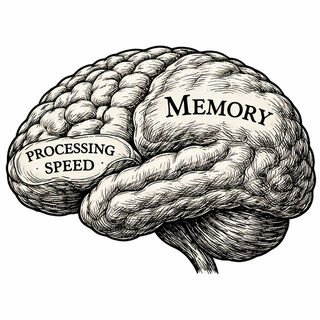
A neurologist walks into a bar and says, "Maybe we’ve been blaming the wrong brain skill for thirty years," which is not a great way to get served quickly, but it is an excellent summary of a new paper in Brain. For a long time, the standard story about cognition in multiple sclerosis, or MS, has been that processing speed slows first and memory trouble follows behind it. Sumowski and colleagues took a hard look at that story in people diagnosed and treated in the modern era, and the plot twist is sharp: for many current patients with early relapsing-remitting MS, memory problems show up even when cognitive speed looks basically normal.[1]
The old story had a good run
That older speed-first model did not come from nowhere. It grew out of studies from the 1990s, back when MRI was less refined, diagnosis came later, and disease-modifying therapies were not yet reshaping the course of illness the way they do now.[1][3] So the field built one of its favorite cognitive theories using a much rougher version of MS. Helpful, yes. Timeless, not so much.
The new study looked at two groups: a case-control cohort of people with early relapsing-remitting MS, and a real-world clinical cohort of 1,004 patients screened between 2018 and 2025. Across both, the headline stayed consistent: memory difficulties were common, but processing speed in many patients was not obviously impaired. In the early-disease group, patients underperformed healthy controls on memory, not speed, and speed stayed stable over six years even as memory slipped a bit.[1]
That matters because the old model has shaped what clinicians test, what researchers prioritize, and what treatments people try to build. If your measuring stick mostly asks, "How fast can the brain sprint?" you may miss whether it can keep hold of the groceries.
Memory is not one blob wearing a fake mustache
The interesting part is that "memory" here does not just mean forgetting where your keys are, though your keys do love drama. The paper points especially toward working memory and episodic memory.[1] Working memory is the brain’s temporary scratchpad - the system that lets you hold and manipulate information for a few seconds, like remembering part of a phone number long enough to type it. Episodic memory is more about storing and recalling events and experiences. They are related, but not identical.
That distinction lines up with other recent work. A 2023 study found that MS lesions linked to memory problems mapped onto a specific memory circuit centered on the hippocampus and related regions, rather than simply reflecting total lesion burden everywhere.[5] So this is not just "the brain is generally having a bad day." Certain memory networks may be taking more of the hit.
Why this changes the vibe in clinic
Clinicians have known for years that cognitive problems in MS can include memory, divided attention, working memory, and the deeply irritating experience of knowing exactly what word you want and having your brain reply, "best I can do is shrug."[1][2] Cleveland Clinic and the VA both describe word-finding, working memory, and cognitive fatigue as common real-life complaints, the kind that mess with jobs, conversations, and daily routines.[6][7]
What Sumowski’s paper adds is a challenge to the pecking order. If modern MS often preserves speed better than older cohorts did, then screening and treatment should probably stop acting as if speed is the sole headliner and memory is just the opening act.
That could affect everything from which tests clinics use to how trials define success. Leavitt, in a 2026 commentary on the paper, argues that the field needs better tools than a single speed-heavy screening culture can provide.[2] Fair point. If your smoke detector only notices one kind of fire, that is not a detector. That is a hobby.
The bigger picture, and the catch
None of this means processing speed no longer matters. It still does, especially in secondary-progressive MS, where the study did find speed and executive deficits.[1] And more broadly, MS remains a disease of inflammation, demyelination, and neurodegeneration, with progressive forms involving chronic tissue-restricted damage and glial dysfunction that still leave researchers playing catch-up.[4]
But if these findings hold up, the real-world impact could be substantial. Better memory-focused assessment might catch cognitive changes earlier. Better models of working memory failure might lead to smarter rehabilitation, more tailored workplace accommodations, and maybe eventually treatments that target the right circuits instead of politely missing them.
Sometimes science advances with a trumpet blast. Sometimes it advances when someone rechecks an old assumption and discovers the emperor is not naked exactly, just wearing very outdated neuropsychology.
References
- Sumowski JF, Levy S, Katz Sand I, et al. Cognition in multiple sclerosis within the modern diagnostic and treatment era. Brain. 2026;149(5):1732-1749. DOI: 10.1093/brain/awaf446. PMCID: PMC13140566.
- Leavitt VM. Forget processing speed: cognitive changes in multiple sclerosis call for new measurement tools. Brain. 2026;149(5):1426-1427. DOI: 10.1093/brain/awag107.
- McGinley MP, Goldschmidt CH, Rae-Grant AD. Diagnosis and Treatment of Multiple Sclerosis: A Review. JAMA. 2021;325(8):765-779. DOI: 10.1001/jama.2020.26858. PubMed: 33620411.
- Garton T, Gadani SP, Gill AJ, Calabresi PA. Neurodegeneration and demyelination in multiple sclerosis. Neuron. 2024;112(19):3231-3251. DOI: 10.1016/j.neuron.2024.05.025. PMCID: PMC11466705.
- Kletenik I, Cohen AL, Glanz BI, et al. Multiple sclerosis lesions that impair memory map to a connected memory circuit. Journal of Neurology. 2023;270(11):5211-5222. DOI: 10.1007/s00415-023-11907-8. PMCID: PMC10592111.
- Cleveland Clinic. Identifying and Managing Cognitive Disorders in Multiple Sclerosis Fact Sheet. https://my.clevelandclinic.org/departments/neurological/depts/multiple-sclerosis/ms-approaches/identifying-managing-cognitive-disorders-in-ms
- U.S. Department of Veterans Affairs Multiple Sclerosis Centers of Excellence. Cognitive Changes and Multiple Sclerosis. Last updated April 14, 2026. https://www.va.gov/MS/SYMPTOMS/Cognitive_Changes_and_Multiple_Sclerosis.asp
Disclaimer: The image accompanying this article is for illustrative purposes only and does not depict actual experimental results, data, or biological mechanisms.