Monday: normal brain. Tuesday: still normal. Wednesday: everything changed, because someone opened the scientific equivalent of a haunted attic and found 125 years of brain slices waiting for their comeback tour.
That is basically the plot of Katrin Amunts' new piece on the Vogt Collection, a gigantic archive started by Cécile and Oskar Vogt more than a century ago. The collection includes about 850,000 histological sections, material from roughly 1,600 human brains, samples from more than 100 animal species, and a paper trail so large it could make a tax accountant cry into a microscope [1]. For years, much of it sat preserved but underused.
Why should you care? Because these are not random old slides in a dusty cabinet. They are detailed tissue sections showing how brain cells and myelin are arranged - the microscopic neighborhood map of the nervous system. If MRI is the satellite view, histology is the street-level footage.
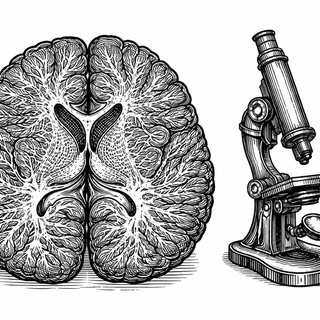
The Vogts helped build the intellectual world that gave us cortical maps in the first place. Korbinian Brodmann worked with them, and his numbered brain areas became the celebrity version of cortical mapping. But the Vogts also pushed myeloarchitecture, which looks at the arrangement of myelin fibers, not just the cells themselves [1]. In plain English: they were checking the wiring in the walls too.
Old Slides, New Tricks
The paper's central idea is delightfully modern: digitize the whole thing, line it up with contemporary 3D brain atlases like BigBrain and EBRAINS, and let present-day neuroscience interrogate historical tissue with tools the Vogts could not have imagined [1,2].
That matters because brain mapping has entered a golden age. Recent atlas studies can now classify thousands of brain cell types, place them in 3D, and connect anatomy to gene expression at enormous scale [5,6]. Researchers are also pushing toward biologically annotated connectomes, where wiring diagrams are linked to the local cellular makeup [4]. The point is no longer just "where is this region?" but "what is it made of, and how is it wired?" [2-4]
The Vogt Collection could become a bridge between eras. Historical sections often contain alternating Nissl and myelin stains, which means scientists may be able to reconstruct 3D histological volumes, align them to modern reference spaces, and compare old tissue architecture with current imaging, molecular, and connectivity datasets [1]. It lets old observations stop being anecdotes and start becoming interoperable data.
Why This Is More Than Museum Rehab
There is a practical reason neuroscience keeps obsessing over fine-grained maps. Brain disorders rarely respect the chunky borders we draw in textbooks. Depression, epilepsy, schizophrenia, dementia, and movement disorders all involve networks and microcircuits, not one tiny villain twirling a mustache in the frontal lobe. Better microarchitectural maps help researchers connect function to actual tissue organization, which is exactly the gap modern neuroscience is trying to close [2,3].
So if the Vogt material becomes searchable, aligned, and FAIR - findable, accessible, interoperable, reusable - it could sharpen work in neurology and psychiatry in two ways. First, it may improve reference maps for healthy and diseased brains. Second, it offers long-span historical material from brains of different ages, clinical backgrounds, and species, which could support fresh questions about variation, disease, and classification [1].
There is also a less glamorous but deeply important angle: reproducibility. Old anatomical descriptions can be rich and beautiful and maddeningly hard to reproduce. Digitization makes re-checking possible. It turns "trust us, the border is right there" into something other scientists can inspect and measure.
The Ethical Footnote Is Actually the Main Plot Twist
This story is not just scientific. It is ethical. Amunts notes that some sections in the collection are tied to victims of Nazi euthanasia programs and have been removed from research use, with deeper investigation planned [1]. That point should not sit quietly in the corner like a polite endnote. It changes the meaning of the whole project.
Reactivating a historical brain collection is not a matter of slapping a scanner on old slides and calling it innovation. It means documenting provenance, confronting how material was acquired, and deciding what responsible use looks like now. In that sense, the collection is not just a resource for brain science. It is also a resource for the history and ethics of science.
The real charm of this paper is that it does not promise a magic cure or one weird trick for psychiatry. It offers something slower and more durable: better maps, richer context, and a chance to connect the long weather of neuroscience history to today's data-heavy storm. Sometimes progress looks like a shiny new machine. Sometimes it looks like opening an old cabinet and realizing the future has been waiting there the whole time.
References
- Amunts K. The Vogt Collection: reactivating a treasure facilitating brain research, neurology and psychiatry. Brain. 2026;149(1):2-5. DOI: https://doi.org/10.1093/brain/awaf365
- Zachlod D, Palomero-Gallagher N, Dickscheid T, Amunts K. Mapping Cytoarchitectonics and Receptor Architectonics to Understand Brain Function and Connectivity. Biol Psychiatry. 2023;93(5):471-479. DOI: https://doi.org/10.1016/j.biopsych.2022.09.014
- Paquola C, Amunts K, Evans A, Smallwood J, Bernhardt B. Closing the mechanistic gap: the value of microarchitecture in understanding cognitive networks. Trends Cogn Sci. 2022;26(10):873-886. DOI: https://doi.org/10.1016/j.tics.2022.07.001
- Arnatkeviciute A, Fulcher BD, Oldham S, et al. Towards a biologically annotated brain connectome. Nat Rev Neurosci. 2023;24(12):747-760. DOI: https://doi.org/10.1038/s41583-023-00752-3
- Jorstad NL, Close JL, Johansen N, et al. Transcriptomic cytoarchitecture reveals principles of human neocortex organization. Science. 2023;382(6678):eadf6812. DOI: https://doi.org/10.1126/science.adf6812
- Zhang M, Pan X, Jung W, et al. Molecularly defined and spatially resolved cell atlas of the whole mouse brain. Nature. 2023;624(7991):343-354. DOI: https://doi.org/10.1038/s41586-023-06808-9. PMCID: https://pmc.ncbi.nlm.nih.gov/articles/PMC10719103/
Disclaimer: The image accompanying this article is for illustrative purposes only and does not depict actual experimental results, data, or biological mechanisms.