
The ice in your glass clinks, the sound hits your eardrum, rides the auditory nerve, checks in with the brainstem, swings through the thalamus, lands in auditory cortex, and then keeps traveling on white matter highways to other regions that decide whether that noise means "nice cocktail bar" or "someone dropped a wrench." Hearing is not a solo. It is an ensemble, and the wiring between players matters.
For a long time, white matter got treated like the road crew at a concert - essential, sure, but not exactly the headliner. Gray matter got the glamor. White matter, packed with long myelinated axons, was cast as passive cabling.
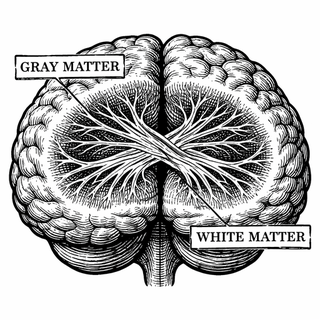
This new study in Brain basically says: maybe stop ignoring the cables, because the cables are humming during seizures too [1].
Andrew Revell and colleagues studied 29 people with drug-resistant epilepsy who underwent stereo-EEG, where electrodes are implanted deep in the brain to map where seizures start and spread. Clinically, doctors usually focus on gray matter contacts. White matter contacts often get sidelined because they can look like messy echoes from nearby tissue.
But in this dataset, white matter did not look like useless static. During seizures, its recordings showed distinctive connectivity changes, and those patterns lined up with the structural tracts linking gray matter regions. In plainer English: the signals looked a lot like information moving between brain areas, not just random spillover from the neighbors [1].
Not A Bonfire, More Like A Group Chat Gone Wrong
That matters because epilepsy increasingly looks less like a single tiny spark plug and more like a network problem. Sometimes there really is a focal seizure onset zone. Sometimes several regions help each other misbehave until the whole system tips into seizure mode. Like a group chat where no one starts the drama alone, but somehow everyone is suddenly typing in all caps.
This paper supports that distributed-network view. The authors found that white matter connectivity to the presumed seizure onset zone was higher in patients who later had poorer surgical outcomes [1]. If the "bad" region is tightly linked to far-flung wiring, simply zapping or removing one spot may be like deleting one troublemaker from the chat while the rest of the chaos squad keeps posting.
Other recent work points the same way. A 2023 Brain review argued that epilepsy surgery is moving toward network-based biomarkers, not just eyeballing where the first weird squiggle appears [2]. Another Brain study found that spike propagation patterns predicted surgical outcome better than some standard seizure-onset measures [3]. An EBioMedicine study showed that combining diffusion MRI with intracranial EEG abnormalities can improve localization of epileptogenic tissue [4].
Why You Should Care Even If You Do Not Spend Weekends Reading EEG Traces
About 50 million people worldwide live with epilepsy, according to the World Health Organization, and a substantial minority have drug-resistant disease [5]. For those patients, surgery or implanted devices can be life-changing, but only if clinicians can identify the right target. The brain is not labeled like an IKEA bookshelf, and seizures do not politely stay in one room.
If white matter recordings really do capture traffic between regions, they could become a useful extra map for treatment planning. Maybe not a magical cheat code. Neuroscience rarely gives those out.
It could help surgeons judge whether a seizure network is compact enough for focal treatment or spread out enough that a device-based strategy makes more sense [1-4]. It could also explain why some surgeries fail even when the visible hotspot gets removed. The hotspot might be real, but it may not be working alone [1,4]. More broadly, it nudges the field toward treating white matter as active physiology, not just packing material.
The Catch, Because There Is Always A Catch
This was not a giant population study. It involved 29 patients, with diffusion imaging available for a smaller subset. These were also people already undergoing invasive monitoring for severe, drug-resistant epilepsy, so you should not generalize the findings to every seizure disorder on Earth. And the study does not prove that white matter alone should guide surgery tomorrow morning.
What it does do is make the old assumption - that white matter recordings are basically disposable background noise - look a lot shakier [1].
That is the useful correction here. Sometimes science advances by realizing the "boring" wire under the floorboards has been carrying the melody the whole time.
References
- Revell AY, Jaskir M, Lucas A, et al. White matter signals reflect information transmission between brain regions during seizures. Brain. 2026;149(1):77-97. doi:10.1093/brain/awaf444. PubMed: 41340548
- Bernabei JM, Li A, Revell AY, et al. Quantitative approaches to guide epilepsy surgery from intracranial EEG. Brain. 2023;146(6):2248-2258. doi:10.1093/brain/awad007. PubMed: 36623936
- Matarrese MAG, Loppini A, Fabbri L, et al. Spike propagation mapping reveals effective connectivity and predicts surgical outcome in epilepsy. Brain. 2023;146(9):3898-3912. doi:10.1093/brain/awad118. PMCID: PMC10473571
- Horsley JJ, Thomas RH, Chowdhury FA, et al. Complementary structural and functional abnormalities to localise epileptogenic tissue. eBioMedicine. 2023;97:104848. doi:10.1016/j.ebiom.2023.104848. PMCID: PMC10602117
- World Health Organization. Epilepsy. Fact sheet updated February 7, 2024. https://www.who.int/news-room/fact-sheets/detail/epilepsy
Disclaimer: The image accompanying this article is for illustrative purposes only and does not depict actual experimental results, data, or biological mechanisms.