Try naming a virus that could stir up trouble in your nervous system years after a lousy case of mono. Not easy, right? Most of us file Epstein-Barr virus, or EBV, under "teenage misery, soup, and canceled plans." But scientists keep finding signs that it may be mixed up in multiple sclerosis.
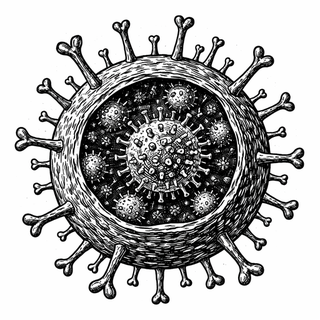
EBV is one of those viruses that loves a long stay. After infection, it usually doesn't pack its bags and leave. It hangs out quietly inside B cells in a latent state, like a houseguest who says, "I’m barely here," while secretly rearranging your furniture.
That matters because MS is a disease where the immune system attacks the brain and spinal cord. Over the last few years, the EBV-MS connection has gone from "interesting theory" to "this is getting awkwardly convincing." A huge 2022 Science study found that MS risk jumped dramatically after EBV infection, and later reviews argued that EBV is likely a leading cause in at least some cases of MS [2,3]. Another study found antibodies from people with MS can recognize both an EBV protein called EBNA1 and a brain protein called GlialCAM, which is exactly the kind of molecular mix-up you do not want your immune system improvising [4].
So the question becomes: if EBV is helping light the match, can we go after the virus?
Enter Brincidofovir, the Viral Party Crasher
That’s where the new paper comes in. Donaldson and colleagues tested brincidofovir, an antiviral drug already approved in the US for smallpox, against EBV and a closely related monkey virus called CalHV-3 [1].
The researchers did not give the drug to people with MS. They studied infected cells in the lab using:
- EBV-infected B cell lines made from people with MS and healthy controls
- Immune cells from blood samples
- Cells from common marmosets naturally infected with CalHV-3, an EBV-like gammaherpesvirus
EBV is annoyingly hard to study directly, and the marmoset virus gives researchers a better model than the usual "close enough, probably" approach.
What Actually Happened in the Lab?
Brincidofovir significantly reduced signs of viral reactivation in both the human EBV system and the marmoset CalHV-3 system [1]. In plain English: when the virus tried to switch from quiet squatter mode into active copy-machine mode, the drug made that much harder.
The study also found lower levels of both lytic and latent viral transcripts. That matters because EBV’s trick is persistence. It hides, reactivates, nudges immune cells around, then acts innocent. Like a tiny biological mob boss with excellent PR.
The likely mechanism is straightforward. Brincidofovir is a lipid-modified cousin of cidofovir, and once inside cells it interferes with viral DNA polymerase - basically jamming the machinery the virus uses to copy its genome [1].
Why This Is More Interesting Than "Drug Lowers Virus in a Dish"
Here’s the sneaky part. This study is not exciting because it "cures MS." It absolutely does not show that. It is exciting because it attacks one of the field’s biggest headaches: if EBV really helps drive MS, researchers need ways to target EBV itself, not just calm down the immune system after the chaos starts.
That broader idea is gaining momentum. A 2025 review in CNS Drugs laid out the case for repurposing licensed anti-EBV drugs for MS, and a 2023 Lancet Neurology review argued that EBV could be a real prevention and treatment target rather than just a suspect who keeps showing up at the crime scene [5,6]. Clinicians are also talking seriously about EBV vaccines and therapies aimed at EBV-infected B cells [7].
That said, the reality check matters. EBV infects more than 90% of adults, and most of those people do not get MS. So EBV probably is not a lone supervillain. It looks more like the badly behaved member of a larger cast that includes genetics, immune regulation, and environmental factors. Lab success also does not guarantee patient success.
The Real Takeaway
This paper gives the field something it badly needs: a plausible antiviral candidate and a workable primate model for testing it [1]. You cannot build smarter MS treatments if your strategy is basically "shrug, then hope."
If future studies show that tamping down EBV activity actually changes disease biology in people with MS, that would be a major shift. Not because it would make MS simple - this disease clearly missed the memo on simplicity - but because it would mean one part of the process is finally targetable in a direct way.
For now, brincidofovir is best seen as an early signal, not a final answer. Still, it is the kind of signal researchers want: specific, plausible, and annoying for anyone still hoping EBV is just an innocent bystander.
References
- Donaldson A, Druker MR, Monaco MC, et al. Broad-spectrum antiviral brincidofovir inhibits Epstein-Barr virus and related gammaherpesvirus in human and nonhuman primate cells. J Clin Invest. 2026;136(2):e195764. DOI: 10.1172/JCI195764
- Bjornevik K, Cortese M, Healy BC, et al. Longitudinal analysis reveals high prevalence of Epstein-Barr virus associated with multiple sclerosis. Science. 2022;375(6578):296-301. DOI: 10.1126/science.abj8222
- Bjornevik K, Münz C, Cohen JI, Ascherio A. Epstein-Barr virus as a leading cause of multiple sclerosis: mechanisms and implications. Nat Rev Neurol. 2023;19:160-171. DOI: 10.1038/s41582-023-00775-5
- Lanz TV, Brewer RC, Ho PP, et al. Clonally expanded B cells in multiple sclerosis bind EBV EBNA1 and GlialCAM. Nature. 2022;603:321-327. DOI: 10.1038/s41586-022-04432-7
- Li V, McKay FC, Tscharke DC, et al. Repurposing Licensed Drugs with Activity Against Epstein-Barr Virus for Treatment of Multiple Sclerosis: A Systematic Approach. CNS Drugs. 2025;39(3):305-320. DOI: 10.1007/s40263-024-01153-5
- Aloisi F, Giovannoni G, Salvetti M. Epstein-Barr virus as a cause of multiple sclerosis: opportunities for prevention and therapy. Lancet Neurol. 2023;22(4):338-349. DOI: 10.1016/S1474-4422(22)00471-9
- Yale Medicine. Could an Epstein-Barr Virus (EBV) Vaccine Help Prevent Multiple Sclerosis (MS)? Published September 24, 2024. Available at: yalemedicine.org/news/ebv-vaccine-help-prevent-multiple-sclerosis
Disclaimer: The image accompanying this article is for illustrative purposes only and does not depict actual experimental results, data, or biological mechanisms.