Some buildings look calm only because the control room is doing an absurd amount of work. Your body is like that. Heart rate, body temperature, sweating, fuel use - all the supposedly automatic stuff depends on the sympathetic nervous system, a building manager with a caffeine problem. A 2025 mouse study suggests these neurons may not organize themselves alone. Their target organs appear to send instructions upstream, telling them how to build the support team they need.[1]
The Tiny Control Room Next Door
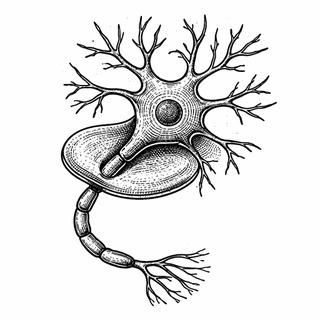
Inside sympathetic ganglia, neurons do not sit by themselves like rugged individualists. They are wrapped by satellite glial cells, flat support cells that hug neuronal cell bodies so closely they may as well be reading over their shoulders. Scientists have suspected that these glia help keep the local environment stable and regulate neuronal activity, but the wiring diagram for how the partnership gets assembled has been murky.[2][3]
Kumari and colleagues went after that question in mice. Their central idea was neat: maybe the organs being innervated are not passive recipients of sympathetic commands. Maybe they are sending feedback that helps construct the neuron-glia unit back in the ganglion, like a tenant emailing the building engineer to say the thermostat is broken and, by the way, the walls are weird.[1]
A Long-Distance Memo From the Organs
The paper focuses on NGF, short for nerve growth factor. NGF is one of those molecules neuroscience keeps finding under every loose floorboard because it does a lot of developmental and maintenance work. In sympathetic neurons, NGF made by target tissues is taken up at nerve endings and shipped backward to the cell body - retrograde signaling, which is a fancy term for "the message travels from the far end of the wire back to headquarters."[1][4]
In this study, that return message turned out to control expression of a neuronal surface protein called DNER. When the researchers deleted DNER specifically in sympathetic neurons, the close contacts between neurons and satellite glia fell apart. The neurons also looked abnormal: their cell bodies were smaller, their target tissues became hyper-innervated, and the neurons were more electrically active. At the whole-animal level, the mice had faster heart rates and greater thermogenesis, which fits with a stronger sympathetic tone.[1]
That is the reveal here. The target organ is not just a room receiving power. It is influencing how the upstream switchboard gets built.
Why That Matters Outside the Mouse House
This matters because sympathetic overactivity shows up in a long list of human problems, especially cardiovascular disease. Clinical and translational reviews keep circling the same point: when sympathetic output runs too hot for too long, the body pays for it in blood pressure, cardiac strain, metabolic trouble, and general wear-and-tear that feels less "fight or flight" and more "reply-all at 2:13 a.m."[5][6]
Recent work has already shown that sympathetic satellite glia are not decorative packing material. A 2022 study found that removing these glia, or disrupting a key potassium-handling mechanism in them, increased sympathetic neuron activity and pushed mice toward signs of autonomic imbalance such as elevated heart rate.[2] Other work has shown that satellite glia come in multiple subtypes, suggesting this is less a blob of support tissue and more a small staff with different job descriptions.[3] A 2025 review in Neuron argues that satellite glia may shape how the body talks to the brain across sensory and autonomic systems, not just mop the floors after neurons are done being dramatic.[6]
So if this new NGF-DNER pathway holds up, it offers a plausible mechanism for how end organs help tune the very circuits that control them. That kind of feedback design is elegant, slightly nosy, and exactly the sort of thing biology loves.
The Catch, Because There Is Always One
This is still a mouse study, and mouse autonomic circuitry is not a shrink-wrapped stand-in for human disease. The work also does not mean DNER is suddenly the master switch for hypertension or dysautonomia. What it does offer is a mechanistic foothold. Instead of saying "neuron-glia interactions probably matter," the paper points to one specific route by which target-derived NGF helps assemble those interactions.[1]
That is useful because the field has been moving away from a neuron-only view of peripheral circuits. Reviews from 2021 to 2025 have emphasized that autonomic pathways are diverse, glia-rich, and more dynamic than the old textbook version where neurons bark orders and everyone else carries boxes.[4][6][7]
The bigger implication is practical. If sympathetic disorders involve misassembled or unstable neuron-glia units, then future therapies might aim not only to damp nerve firing, but to repair the local architecture that keeps firing under control in the first place. Less smashing the alarm bell with a hammer. More fixing the control panel.
References
- Kumari R, Boehm E, Pascalau R, Pfeiffer RL, Jones BW, Tampakakis E, Kuruvilla R. Retrograde control of sympathetic neuron-satellite glia interactions by target-derived NGF signaling. Cell Reports. 2025;44(12):116697. DOI: https://doi.org/10.1016/j.celrep.2025.116697. PMCID: https://pmc.ncbi.nlm.nih.gov/articles/PMC12821072/
- Mapps AA, Boehm E, Beier C, Keenan WT, Langel J, Liu M, Thomsen MB, Hattar S, Zhao H, Tampakakis E, Kuruvilla R. Satellite glia modulate sympathetic neuron survival, activity, and autonomic function. eLife. 2022;11:e74295. DOI: https://doi.org/10.7554/eLife.74295. PMCID: https://pmc.ncbi.nlm.nih.gov/articles/PMC9433091/
- Mapps AA, Thomsen MB, Boehm E, et al. Diversity of satellite glia in sympathetic and sensory ganglia. Cell Reports. 2022;38(6):110328. DOI: https://doi.org/10.1016/j.celrep.2022.110328
- Scott-Solomon E, Boehm E, Kuruvilla R. The sympathetic nervous system in development and disease. Nature Reviews Neuroscience. 2021;22:685-702. DOI: https://doi.org/10.1038/s41583-021-00523-y
- Grassi G, Mancia G, Esler M. Sympathetic overactivity, hypertension and cardiovascular disease: state of the art. Current Medical Research and Opinion. 2024;40(sup1):5-13. DOI: https://doi.org/10.1080/03007995.2024.2305248
- Meriau P, Kuruvilla R, Cavalli V. Satellite glial cells: Shaping peripheral input into the brain-body axis? Neuron. 2025;113(20):3333-3351. DOI: https://doi.org/10.1016/j.neuron.2025.05.031
- Wang T, Tufenkjian A, Ajijola OA, et al. Molecular and functional diversity of the autonomic nervous system. Nature Reviews Neuroscience. 2025;26:607-622. DOI: https://doi.org/10.1038/s41583-025-00941-2
Disclaimer: The image accompanying this article is for illustrative purposes only and does not depict actual experimental results, data, or biological mechanisms.